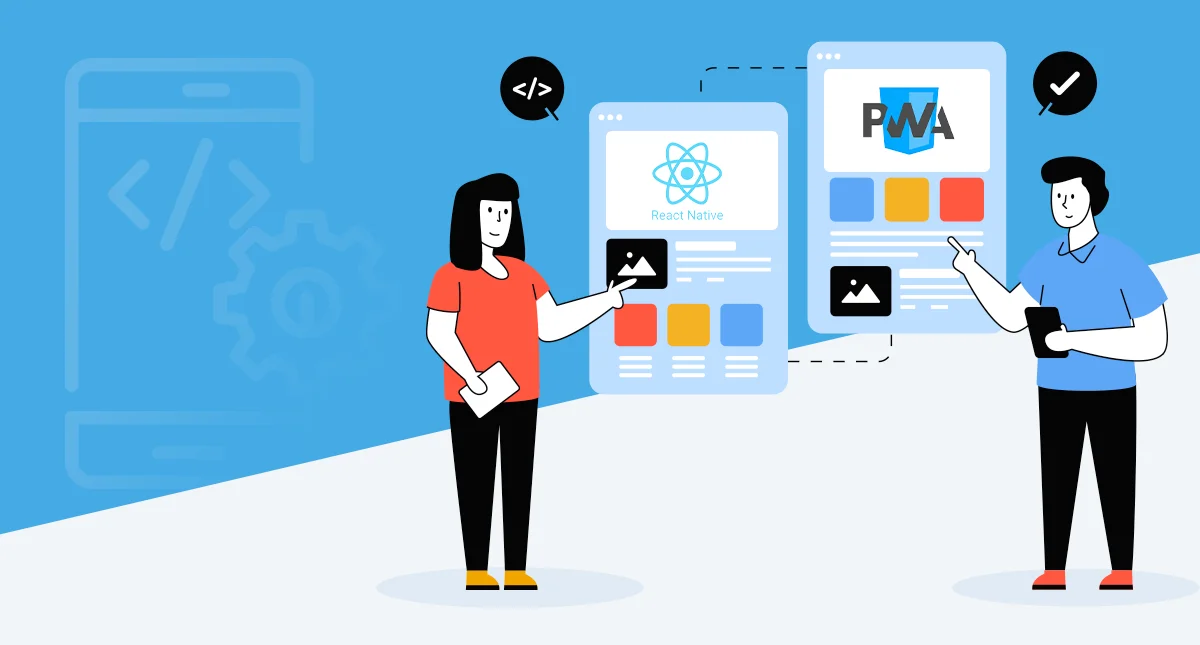
Choosing the right technology for building a mobile experience has become a key strategic decision for modern companies. With users expecting fast, intuitive and reliable applications across all devices, businesses often find themselves comparing two popular approaches: React Native and Progressive Web Apps (PWA). Each offers unique strengths and limitations — and the choice between them can significantly impact development cost, user experience, and long-term scalability.
Why companies face the mobile technology choice
This guide explores why many businesses struggle to decide how to build their mobile presence. With users expecting seamless cross-device experiences, companies must balance performance, cost, development speed, and long-term scalability. As the number of available technologies grows, choosing the right approach is no longer a simple technical decision — it directly impacts user engagement, product quality, and overall business goals.
A quick overview of React Native and PWA
React Native is a framework that allows developers to build mobile applications using JavaScript and React, while still delivering a near-native experience on both iOS and Android. It compiles to native components, giving access to device capabilities and ensuring high performance.
Progressive Web Apps (PWAs), on the other hand, are web applications enhanced with modern browser features such as offline access, push notifications, and installability. They run directly in the browser but can feel similar to native apps—without requiring distribution through app stores.
Together, these two approaches represent fundamentally different paths to delivering mobile experiences: one native-oriented, the other web-driven.
What is React Native?
React Native is a popular framework created by Meta that allows developers to build mobile applications using JavaScript and React. Instead of rendering content in a browser, React Native uses real native components, delivering an experience that feels close to fully native apps on both iOS and Android. This makes it an attractive choice for businesses that want strong performance without building two separate mobile codebases.
How it works and its key features
React Native operates on a “learn once, write anywhere” principle. Developers write UI logic in JavaScript, and React Native bridges this logic to native components and APIs. This hybrid approach combines the speed of web development with the performance of native mobile technology.
Key features include:
- Native components — interfaces render using real iOS/Android UI elements.
- Hot Reloading / Fast Refresh — rapid iteration during development.
- Rich ecosystem — thousands of libraries, packages and community tools.
- Access to device APIs — camera, GPS, accelerometer, haptics, push notifications and more.
- Cross-platform support — the same codebase can target both iOS and Android.
When React Native works best
React Native is an excellent choice when your project requires:
- High-performance mobile interactions (smooth animations, gesture support, native-level user interface).
- Access to advanced device features that PWAs cannot fully support.
- A consistent cross-platform experience without having to build two separate native apps.
- Faster development of complex mobile products such as social networks, fintech applications, or consumer platforms.
- Long-term scalability, where native integration may be needed in the future.
In practice, React Native works well for consumer applications that need to be fast, polished, and reliable.
Examples of well-known React Native apps
Many global companies rely on React Native for major parts of their mobile applications, including:
- Facebook — parts of the main app and Ads Manager
- Instagram — features like the post creation flow
- Shopify — uses React Native extensively in its mobile products
- Walmart — improved performance and development speed using RN
- Discord — Android app rewritten in React Native for performance gains
- Bloomberg — mobile news and media app
These examples highlight React Native’s ability to support apps with millions of active users while maintaining performance and reliability.
What is a PWA (Progressive Web App)?
A Progressive Web App (PWA) is a modern type of web application enhanced with additional capabilities that make it behave more like a native mobile app. PWAs run directly in the browser but can be installed on a user’s home screen, send push notifications, work offline and load extremely fast thanks to technologies like service workers and caching strategies.
Because they rely on standard web technologies and are platform-agnostic, PWAs allow businesses to deliver a mobile-friendly, app-like experience without forcing users to download anything from an app store.
How PWAs work and their key features
PWAs are built using standard web technologies — HTML, CSS and JavaScript — but enriched with modern browser APIs. The core mechanism behind PWAs is the service worker, a background script that controls caching, offline behavior and network optimization.
Key features include:
- Installability — users can add the app to their home screen with one tap, without an app store.
- Offline support — service workers enable PWAs to work even with limited or no internet connection.
- Fast loading — aggressive caching makes PWAs load quickly, even on slow networks.
- Push notifications — supported on many platforms, enabling re-engagement.
- Cross-platform reach — PWAs run on any device with a modern browser.
- Lightweight footprint — apps are small and don’t require installation packages.
PWAs aim to combine the best of web accessibility with the convenience of a mobile application.
When PWAs are the best choice
PWAs work particularly well when a business needs:
- A fast and accessible mobile presence without forcing app installation.
- Lower development and maintenance costs, thanks to a single web-based codebase.
- A strong SEO presence, since PWAs are indexable by search engines.
- Rapid deployment and updates without waiting for App Store or Google Play reviews.
- A lightweight solution that can reach users on any device, anywhere.
- An MVP or early-stage product, where speed and cost-efficiency matter most.
PWAs are ideal when accessibility, reach and frictionless user onboarding are the top priorities.
Examples of companies using PWAs
Many major organizations use PWAs to improve performance, engagement and conversion rates, including:
- Twitter — Twitter Lite reduced data usage and increased retention on low-bandwidth markets.
- Starbucks — PWA doubled daily active users and improved offline access for orders.
- Pinterest — PWA increased sign-ups and user engagement dramatically.
- Spotify — web app behaves almost identically to the native app.
- AliExpress — PWA increased conversion rates for mobile users.
These examples show how PWAs can match or even outperform native apps in reach and speed, especially in global or resource-constrained markets.
React Native vs PWA — Detailed Comparison
User experience (UX)
React Native offers a near-native user experience, using real iOS and Android components. Animations, gestures and navigation feel smooth and natural, making it ideal for complex or highly interactive interfaces.
PWAs deliver a consistent experience across all devices but remain limited by browser capabilities. While modern PWAs feel increasingly app-like, UI performance and interactions may not match the polish of fully native components.
Performance
React Native generally provides higher performance because it uses native modules and views. Apps run efficiently even when handling heavy animations, background processes or large amounts of data.
PWAs are extremely fast when it comes to loading and basic interactions, but they rely on the browser engine. This can introduce limitations for processor-heavy tasks, advanced animations or complex media operations.
Offline capabilities
React Native apps can fully operate offline, storing data locally and syncing with servers when connectivity returns.
PWAs also support offline mode through service workers, allowing caching of pages, assets and content. However, offline capabilities are more limited and depend on how much data can realistically be cached within the browser.
Access to device features (camera, GPS, Bluetooth, push notifications)
React Native provides deep access to device hardware and native APIs, including camera, GPS, file system, accelerometer, Bluetooth and advanced push notifications.
PWAs support some hardware features, but browser restrictions vary by device and platform. While capabilities have improved (e.g., camera access, geolocation, limited notifications), PWAs still cannot access many native features—especially on iOS.
Updates and maintenance
React Native apps traditionally require updates through app stores, but modern tooling has significantly simplified this process. Solutions like Expo offer powerful features such as over-the-air updates (OTA), automated building pipelines and seamless deployment tools. Expo makes it easy to push changes instantly, build native binaries for testing and distribute previews without needing Xcode or Android Studio. This reduces friction in development and speeds up release cycles.
PWAs update instantly, with no user action required. As soon as new code is deployed, every user receives the latest version through the browser. This makes PWAs extremely lightweight and easy to maintain — no app store approvals, no binary builds, and no installation steps.
Development costs
React Native reduces costs by sharing a single codebase across iOS and Android, but some native modules may require platform-specific development.
PWAs are typically the most cost-effective solution because they run on the web and do not require separate mobile builds. Development and maintenance are significantly cheaper—ideal for startups, MVPs or businesses with smaller budgets.
SEO and marketing impact
React Native apps are not indexed by search engines and require separate marketing channels to drive downloads. Marketing in mobile stores relies on App Store Optimization (ASO) — optimizing the app’s name, keywords, screenshots and descriptions to improve discoverability. A common strategy is using descriptive titles (e.g., “Brand – Food Delivery” or “Brand: Meditation & Sleep”), which helps users understand the app instantly and improves search ranking within the store. Ratings, reviews and visual assets also play a major role in attracting downloads.
PWAs can be fully indexed by Google, improving visibility through SEO. They support link sharing, instant access and removing friction from onboarding, making them powerful marketing tools for content-driven or e-commerce businesses.
Distribution (App Store / Google Play vs browser access)
React Native apps must be published through Google Play and the App Store. This adds credibility but requires meeting store guidelines, passing reviews and handling update cycles.
PWAs are accessible instantly through a URL—no installation, no approval processes and no store fees. This dramatically lowers entry barriers and increases reach, especially in global markets or low-bandwidth environments.
Comparison Table
| Category | React Native | PWA |
|---|---|---|
| User Experience (UX) | Near-native look & feel with smooth animations and gestures | App-like, but limited by browser rendering and DOM performance |
| Performance | High performance thanks to native components | Fast loading, but runtime limited by browser engine |
| Offline Capabilities | Full offline support with native storage and sync | Offline support via service workers and cached content |
| Access to Device Features | Full access to camera, GPS, Bluetooth, haptics, file system, sensors, etc. | Partial access, limited by browser APIs (especially on iOS) |
| Updates & Maintenance | Requires store updates, but tools like Expo enable OTA updates and easy builds | Instant updates — deployed like a standard website |
| Development Costs | Medium — single codebase for iOS/Android, occasional native modules | Low — one web app for all platforms |
| SEO & Marketing | Not indexable by search engines, requires app store presence | Fully indexable; strong SEO potential and instant link sharing |
| Distribution | Via App Store & Google Play, requires review and publishing process | Distributed via URL, no store approval or installation needed |
| Scalability | Excellent for long-term, feature-rich mobile products | Excellent for broad reach, limited for advanced native features |
Which technology should you choose?
Choosing between React Native and a PWA ultimately depends on your product’s goals, technical requirements and the stage of your business. Both approaches offer strong benefits — but they shine in very different scenarios.
Choose React Native if:
- You need high-performance mobile apps with smooth animations and native interactions.
- Your product relies on advanced hardware features like Bluetooth, biometrics, background location, haptics, or complex camera use.
- You want to build a scalable long-term mobile product with the potential for deep native integrations.
- You expect users to spend a lot of time in the app (social apps, fintech, productivity tools, communication platforms).
- You’re ready to distribute through App Store and Google Play and benefit from their credibility.
React Native is usually the better choice for feature-rich, interactive and high-performance applications that must feel truly native on both platforms.
Choose a PWA if:
- You need the fastest possible time-to-market and want to keep costs low.
- Your audience benefits from instant access via URL, with no installation barriers.
- SEO matters — for example, e-commerce, content platforms or local services.
- Your product doesn’t require the deepest native capabilities.
- You want to reach the broadest possible audience, including older devices or slow networks.
- You prefer web-like deployment: instant updates, no store approvals, no binary builds.
PWAs are ideal for lightweight apps, early-stage MVPs, and businesses that rely on reach, accessibility and frictionless onboarding.
Conclusion
React Native and PWA offer powerful capabilities for delivering mobile experiences, but they serve different needs. React Native provides near-native performance, deep device integration, and a well-crafted user experience, making it ideal for long-term, feature-rich mobile products. PWAs, on the other hand, stands out for its accessibility, speed of development, and broad reach, offering instant access and significant SEO benefits.
The “right” choice depends on your business goals: whether your priority is performance and native capabilities, or reach and rapid delivery. In many cases, starting with a PWA and evolving to a React Native app after product development can provide the best balance between cost, speed, and scalability.
Both technologies are mature, widely used, and capable of supporting successful digital products—the key is to tailor them to your users’ needs and product vision.
If you are looking for a team which can assist you with mobile app development do not hesitate to reach out to click5 for a consultation. We have experienced team of mobile developers working with React Native and PWA apps.